Design & Fabrication
In Class Plotter Exercise
Project overview
Two Lead-Screw Stages That Draw From G-Code.
In class, we built a single linear stage, then stacked two of them into an X–Y plotter that draws shapes with a marker from G-code.
The exercise was the first linear stage for the larger 2.5-degree-of-freedom project: get one axis moving accurately, then coordinate two. The same motors and control board went on to drive our 2.5 DoF Carnival Fishing machine.
Key Work & Outcomes
- Built a lead-screw linear stage driven by a NEMA 17 stepper and Marlin firmware.
- Stacked two stages at right angles to make an X–Y plotter.
- Drove both axes from an MKS Base board using G-code.
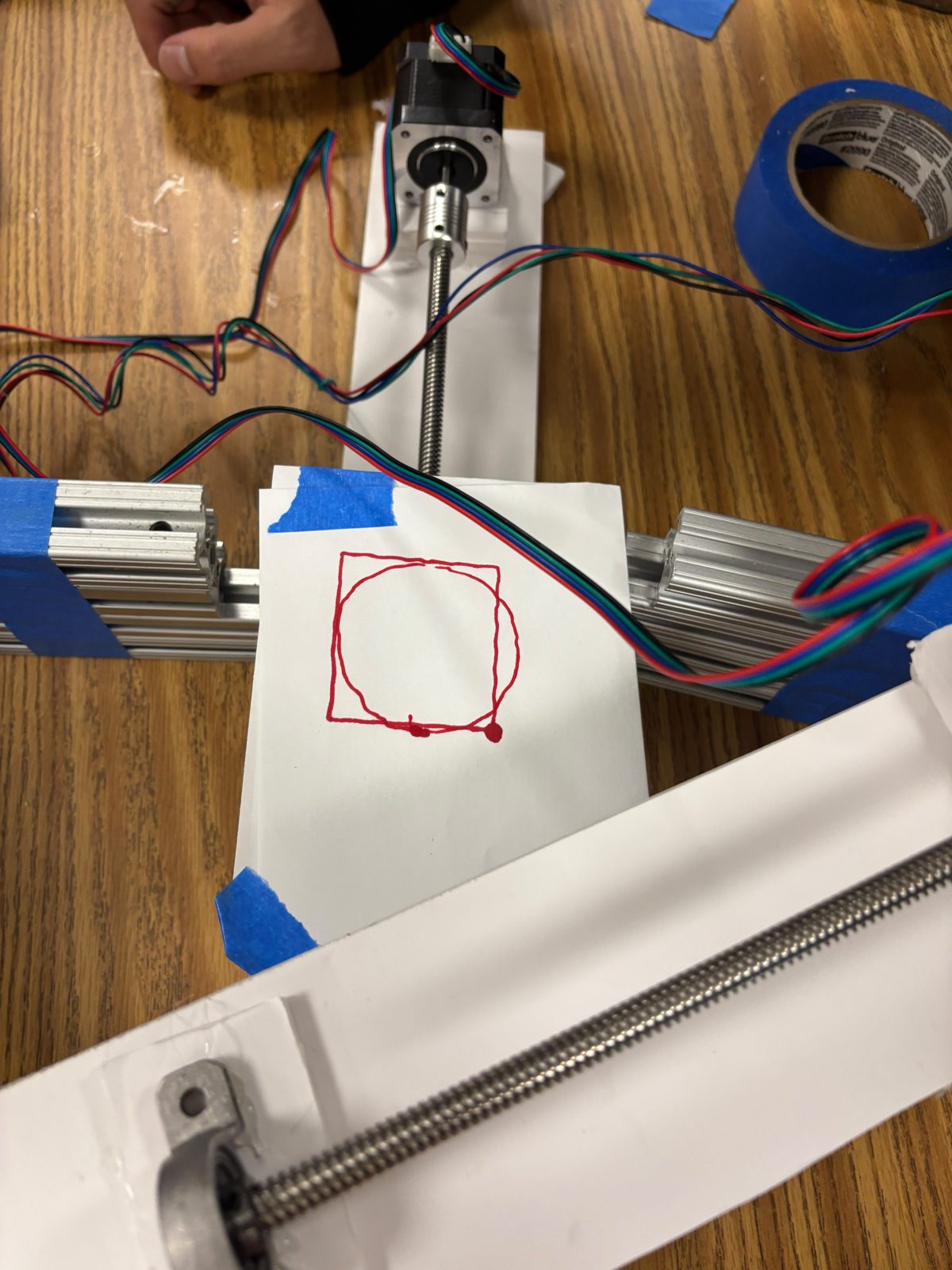
- Drew a square and a circle with a marker as motion tests.
Linear stage
One Axis First
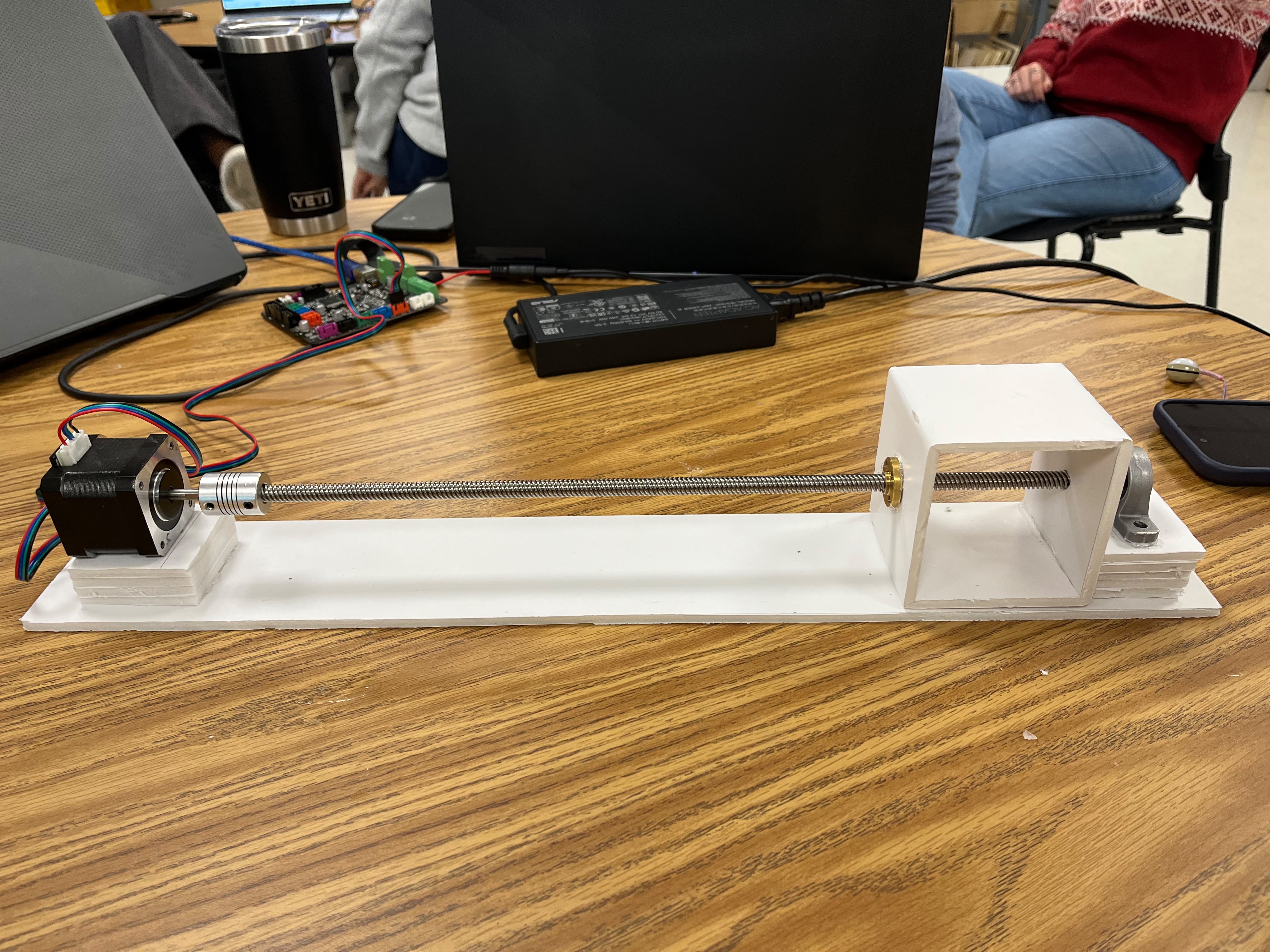
A stepper turns a lead screw, and a brass nut converts that rotation into straight-line travel.
The NEMA 17 motor connects to the lead screw through a flexible coupler, which absorbs small misalignments. The brass nut is fixed to a foam-board carriage, and a pillow-block bearing supports the far end of the screw. The stage runs on an MKS Base board with Marlin firmware, configured at 400 steps/mm for the 8 mm-per-turn lead screw.
Plotting
Two Axes, One Marker
With one stage stacked on the other and a marker in a printed holder, the plotter drew shapes from G-code.
The circle took three lines of G-code: lower the marker, draw a 25 mm-radius arc with G02, and lift the marker.
g1 e25 f250              ; lower the marker
g02 x0 y25 i25 j0 f1000  ; clockwise arc, 25 mm radius
g1 e0 f250               ; lift the marker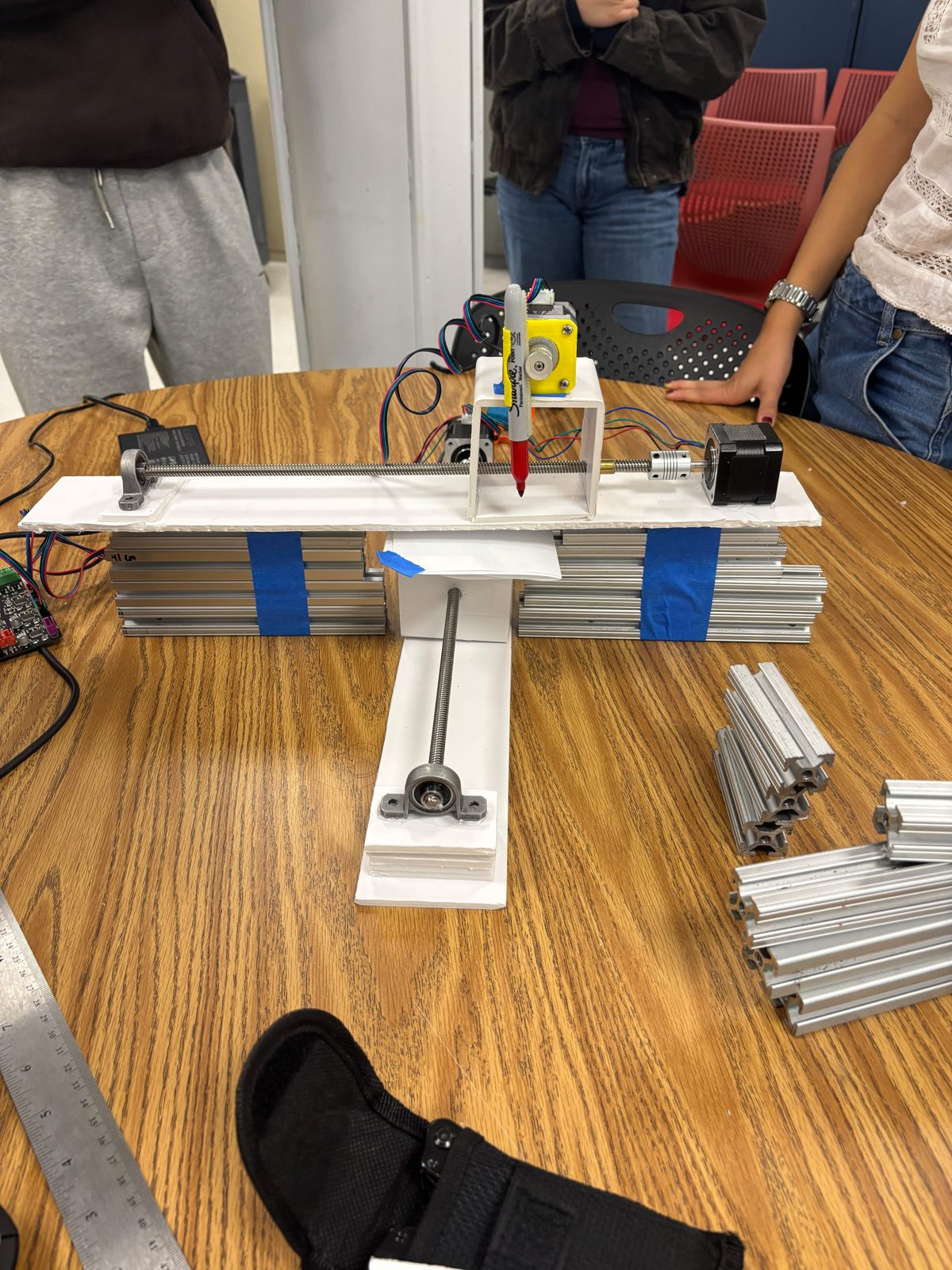
Continue Exploring